Can recycling ease the growing pressure on transition minerals?
An insight piece exploring critical minerals, the risks already embedded in many ETFs, and what it would take to finance more circular supply.
Can recycling ease the growing pressure on transition minerals?
As energy systems shift from burning fossil fuels to cleaner technologies, the need for critical minerals is growing. Copper, cobalt, lithium, nickel, rare earths and other so-called ‘transition minerals’ are central to clean technologies, including electric vehicles, solar panels and wind turbines. If the world cannot secure a sufficient and sustainable supply of the materials needed for clean technologies, the transition may become slower, more expensive and more exposed to geopolitical shocks ().
These challenges may also matter to investors. Clean-energy ETFs can hold companies exposed to mineral-related risks even when those risks are not apparent from a fund’s name. Understanding these exposures can help investors assess potential vulnerabilities, although exposure alone does not establish how an ETF will perform.
This Kilda insight introduces Kilda’s approach to assessing forward-looking, policy-related risks associated with critical minerals. It explains how these risks are reflected in ETF scores. Beyond that, it considers whether recycling could help ease pressure on mineral supply chains over time and how blended finance can help increase recycling efforts.
Understanding Kilda’s analytics
The analytics focus on forward-looking drivers not yet reflected in market prices. Drivers already in force are assumed to be at least partly priced in and are therefore excluded. In the current release, Kilda scores policy risks relating to issues such as export restrictions, biodiversity or community rights that directly affect critical minerals. Each driver is scored on its likelihood of implementation and the potential disruption its implementation could cause.
The resulting scores help investors understand which companies may be exposed to emerging policy-related risks and how those exposures are reflected in their ETF holdings.
Consider the iShares Global Clean Energy ETF (ICLN) as an example. Kilda identifies policy-related critical minerals risks affecting companies representing 62% of the ETF’s portfolio by weight. This figure represents portfolio-weighted coverage of the risks identified by Kilda, not a measure of the proportion of companies that use critical minerals directly. Kilda also assigns ICLN a risk intensity score of 75 out of 100. This reflects the average risk scores of the companies Kilda can assess, weighted by their share of the portfolio. Thus, coverage indicates the proportion of the portfolio associated with identified risks, while intensity indicates the assessed severity of those risks under Kilda’s scoring methodology. It is important to note that Kilda does not predict investment returns or measure the ETF’s overall financial risk.
Comparing ICLN with a broad-market ETF, such as the Vanguard Total World Stock ETF (VT), provides a useful reference point. The funds have different sector and geographic exposures, making this an illustrative comparison rather than a like-for-like benchmark.
Kilda’s assessment indicates that VT has 30 percentage points less portfolio-weighted coverage of the identified risks than ICLN. However, VT’s risk intensity score is 12 points higher. This suggests that, although a smaller share of VT’s portfolio is associated with the identified risks, the assessed companies have higher average risk scores under Kilda’s methodology.The data underlying these claims is as of 15th October 2026.
These figures should be interpreted alongside the underlying holdings, the assessment date and the methodology used to calculate coverage and intensity, which can be found on our website. A lower coverage figure does not necessarily imply lower overall risk, and a higher intensity score does not necessarily imply worse investment performance.
Most of ICLN’s exposure is driven by one holding: Bloom Energy, the fund’s largest position, which makes up 10.04% of assets. This holding is flagged on all five minerals Kilda tracks — cobalt, copper, lithium, nickel and rare earths — and carries a high risk score of 98 out of 100.
shows other holdings, the mineral risks to which they are exposed (‘Mapped minerals’), their respective risk band (red, yellow or green) and risk score (the number in the circle).
Table 1: ICLN’s largest covered holdings, by weight within the covered share of the fund.
Company
Portfolio weight
Industry
Risk score
Mapped minerals
16.18%
Electrical Equipment & Parts
11.07%
Solar
10.92%
Solar
6.8%
Solar
6.77%
Specialty Industrial Machinery
Can circularity ease pressure on mineral supply?
The preceding analytics illustrate how mineral-related policy risks can manifest in an ETF portfolio. The next question is whether greater circularity can reduce pressure on mineral supply chains and how so-called blended finance can help finance such a transformation.
Mining alone cannot close the gap
Supplying transition minerals at the required scale under conventional mining practices would very likely result in considerable social and environmental damage. The impacts include greenhouse-gas emissions from energy-intensive mining and processing, biodiversity loss, pollution, water pressures and human-rights risks (). However, new mining remains crucial, and financing a socially and environmentally responsible energy transition presents a substantial challenge. According to the IEA’s Global Critical Minerals Outlook 2025, meeting demand for critical minerals will require approximately US$500 billion in new mining capital investment by 2040 under its Stated Policies Scenario (STEPS), which reflects policies currently in place, rising to around US$600 billion under the Announced Pledges Scenario (APS), which incorporates announced climate commitments.
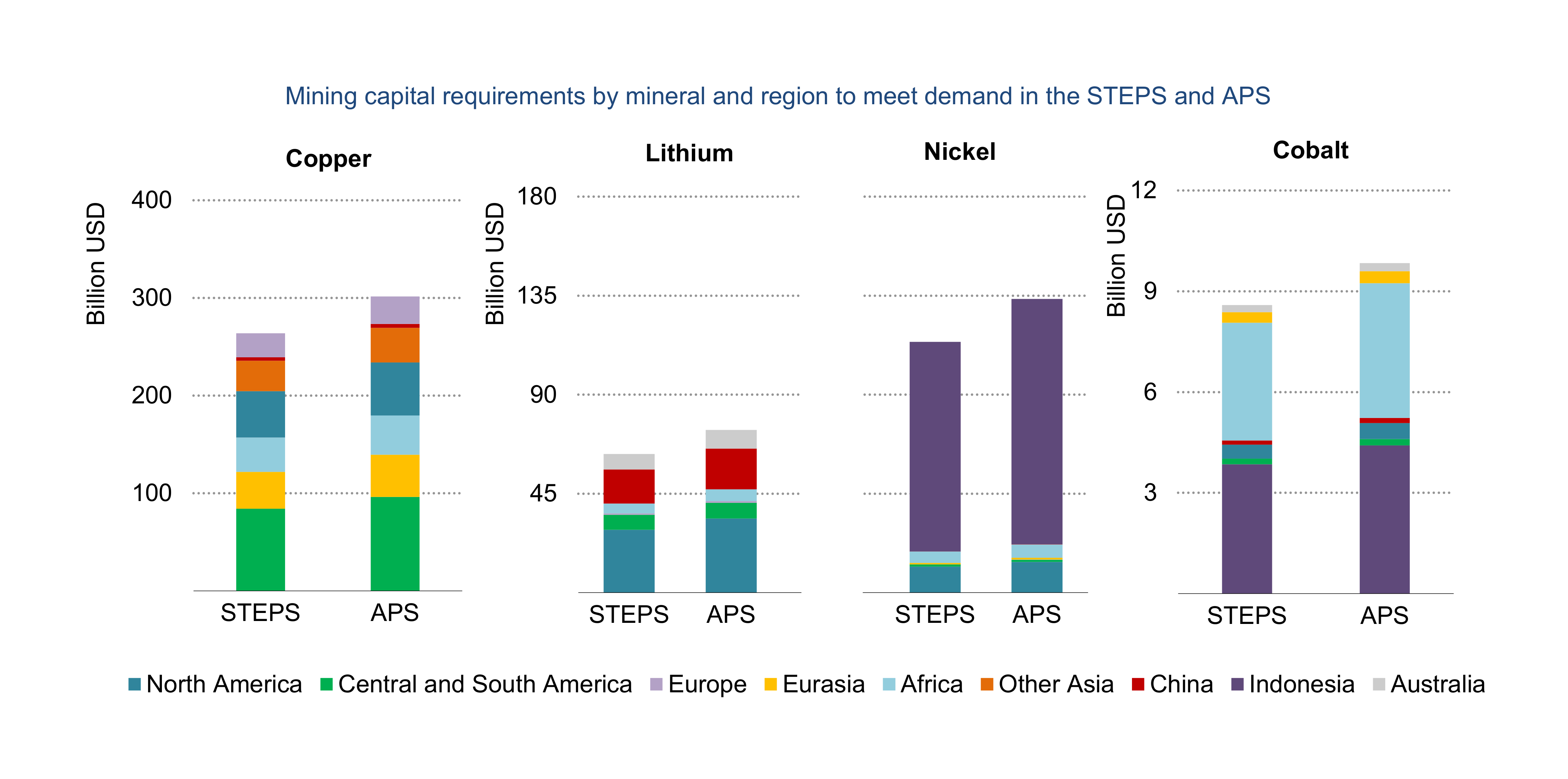
These figures highlight the scale of financing required and show how investment needs depend on the pace of the energy transition () ().
A mindset shift from more supply to better supply
Better product design, smaller batteries where appropriate, material efficiency, substitution and changes in consumption can help reduce the quantity of primary material required and thus lower demand. Integrating circular-economy principles is also essential. The IEA estimates that scaling up critical minerals recycling could reduce the need for new mining activity by 5–30% by 2040 under its Stated Policies Scenario. Increased recycling could also reduce mining investment requirements by around 30% through 2040 compared with a scenario without increased recycling ().
30%
Lower mining investment requirements through 2040 with increased recycling
IEA, 2025
Even under ambitious recycling scenarios, continued investment in primary mineral supply will be needed to meet projected demand and offset declining output from existing mines. The balance between primary and secondary supply will vary by mineral, technology and scenario () ().
The emissions case for recycling is also strong. According to the IEA, recycled energy-transition minerals such as lithium, nickel and cobalt have, on average, around 80% lower greenhouse-gas emissions than primary materials produced through mining (). For investors, increased recycling could potentially reduce ETFs’ exposure to carbon-intensive supply chains and the risks associated with poorly managed extraction, depending on the composition of their underlying holdings. However, sector-wide reductions in emissions do not necessarily translate into lower environmental or financial risk at the fund level.
Making recycling investable
Despite its benefits, recycling itself is not automatically bankable. Material collection can be fragmented, feedstock can be uncertain and recovery yields can vary, while low or volatile commodity prices can reduce recyclers’ revenues and weaken the incentive to invest in recycling infrastructure. High financing costs in emerging markets further increase the need for external finance to develop projects.
Recycling is a good candidate for blended finance. Blended finance offers a practical bridge between public policy objectives and private capital. The OECD defines it as the strategic use of development finance to mobilise additional commercial finance. Public or philanthropic capital can be used to address risks that private investors cannot efficiently absorb, thereby making risky or early-stage projects investable and helping new markets develop (). Established mining projects often do not face the same risks as recycling projects, such as uncertain access to end-of-life materials, volatile metal prices, immature collection infrastructure and technologies that have yet to demonstrate commercial scale (). For critical minerals recycling, government-backed financing and fiscal incentives for recycling infrastructure could take several forms:
- Recycling facilities may be financed through concessional debt. This is a type of debt that allows loans on more favourable conditions than those available commercially, such as lower interest rates. Guarantees work slightly differently by providing protection against specified risks, such as non-payment, in a similar way to insurance.
- A first-loss layer means that the public investor agrees to absorb losses before private investors do. Private investors therefore take a senior position and have a first claim on the project’s cash flow, relative to the public investor, who takes the junior position. This does not make the project less risky but reallocates the risk to enable private capital to flow in.
- Before a recycling project can attract commercial finance, it may need feasibility studies, environmental and social assessments, and support in other areas, such as engineering, supply chains or material collection. This is where grants and technical assistance play an important role. They fund the development of a project until it is investable.
It must be noted that the objective is not to use public money to support uneconomic recycling businesses. Criteria for blended finance include additionality, which means public capital should unlock investment that would not otherwise occur, and concessionality, which means support should be limited to the level needed to attract private finance () (). Capital will not scale simply because an activity is sustainable. Financing a critical minerals recycling strategy requires investable structures, credible policy, reliable data, appropriate risk allocation and visible pathways to return.
What can this mean for private investors?
Research before selecting ETFs can help investors understand the potential risks associated with their investments. Examining how critical minerals recycling is financed, and how the surrounding policy debate is framed, can provide useful context for assessing mineral-related exposures. While recycling may help reduce risks at the sector level by reducing reliance on primary extraction and expanding the range of potential material sources () (), it does not follow that recycling will necessarily improve the performance of a particular ETF. The outcome depends on the composition of the fund’s holdings, the extent to which individual companies benefit from or are exposed to recycling, and the policies and market conditions affecting those companies.
How could recycling affect Kilda’s scores?
Kilda takes a forward-looking approach and currently focuses on policy-driven risks related to critical minerals. It does not score recycling directly.
Each policy is scored according to its likelihood of implementation and its severity — that is, how disruptive it would be once its effects materialise. If upcoming recycling strategies are potent enough to affect a relevant policy driver included in Kilda’s assessment, the score is updated accordingly.
The impact on Bloom Energy’s overall score depends on whether that specific policy was a key driver in the calculation of its score. If lithium policy in Chile were its worst-scoring factor, the change could meaningfully improve Bloom Energy’s score. If a more disruptive factor remains elsewhere, such as a specific policy relating to nickel in another country, the overall score may change very little. If Bloom Energy’s score does improve, ICLN’s policy intensity decreases proportionally to the fund’s holding of Bloom Energy. Coverage, however, remains unchanged, as a change in policy conditions affects the score, not the extent of coverage.
The future supply of critical minerals is unlikely to depend on mining alone. Mining will remain necessary where recycling cannot meet demand. Blended finance can help close this gap by making projects viable and investable. Reducing material demand where possible, keeping products and metals in use for longer, and recovering valuable materials at the end of their life can all reduce pressure on primary supply. How all of this will translate into investors’ portfolios will only be seen in the future. In the meantime, Kilda provides insights into ETFs’ exposure to policy risks, and we are continually working to broaden the range of risks and risk drivers covered by our analytics.
References
- Department for Business & Trade (2025). Vision 2035: Critical minerals strategy. GOV.UK.
- IEA – International Energy Agency (2024a). Executive summary – Global Critical Minerals Outlook 2024 – Analysis. IEA.
- IEA – International Energy Agency (2024b). Executive summary – Recycling of Critical Minerals – Analysis. IEA.
- [...]